

- Discuss the leadership gap in healthcare
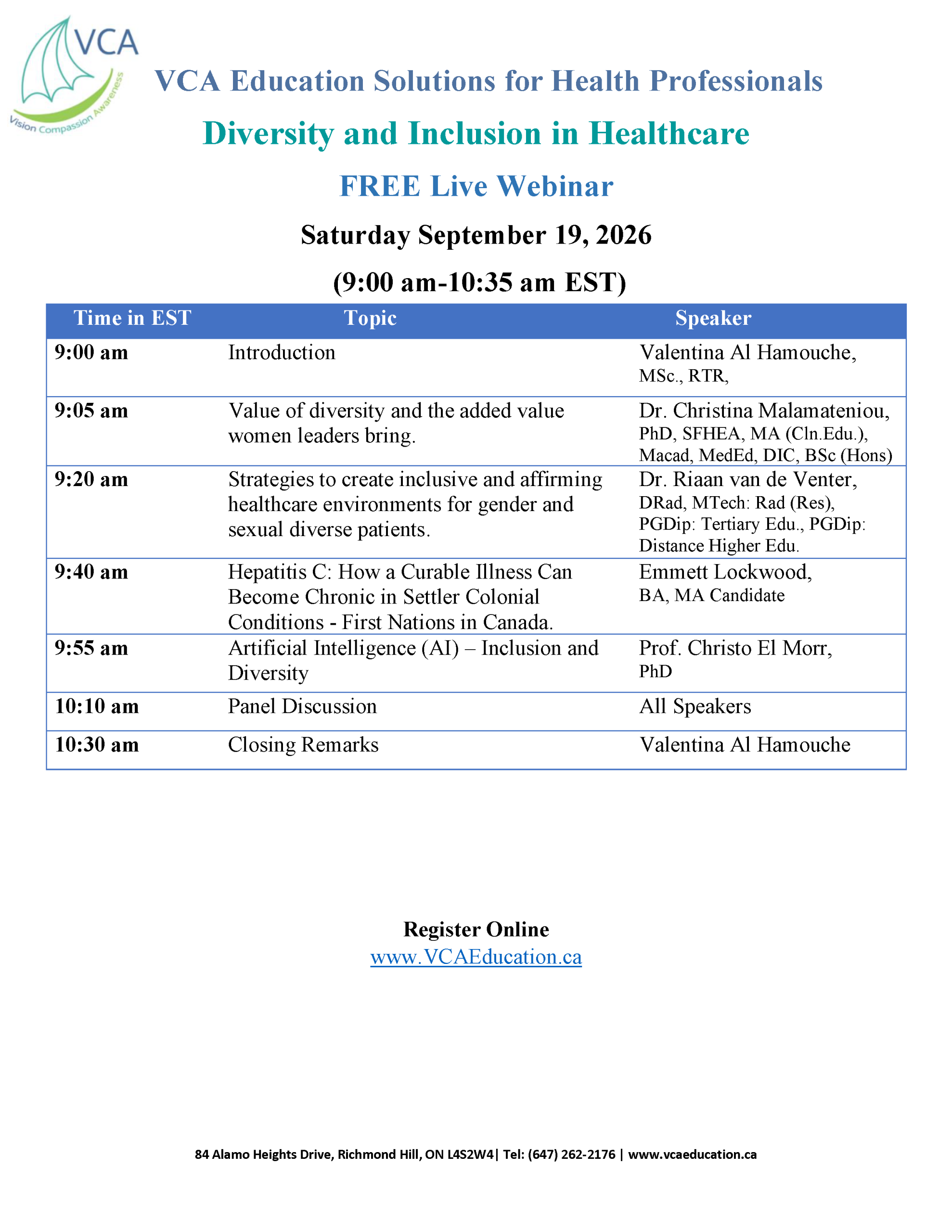
- Explain the benefits of women leaders
- Offer recommendations for practice to improve EDI at the workplace
- Describe current healthcare experiences of gender and sexual diverse patients
- Identify medical radiation technologists’ ethico-legal duties towards gender and sexual diverse patients
- Discuss strategies to create inclusive and affirming healthcare environments for gender and sexual diverse patients
- Understand how the ongoing of settler colonialism impact the availability of healthcare and health resources for First Nations populations in Canada.
- Explore legacies and currents of settler colonialism have led to strained relationships between First Nations populations and healthcare providers.
- Explain the need for culturally informed holistic care in building systems of care to meet the need of First Nations populations in Canada.
- Define what diversity and inclusion mean in the context of artificial intelligence.
- Explain why AI is not neutral, and how data, design choices, and institutional contexts can reproduce social inequalities.
- Identify examples of AI systems that may affect marginalized groups differently, such as hiring tools, health algorithms, facial recognition, education platforms, or policing systems.
- Distinguish between technical bias and broader forms of social exclusion embedded in AI systems.
- Recognize the importance of inclusive AI design, including participation from affected communities, accessibility, fairness, transparency, and accountability.
Short Biographies
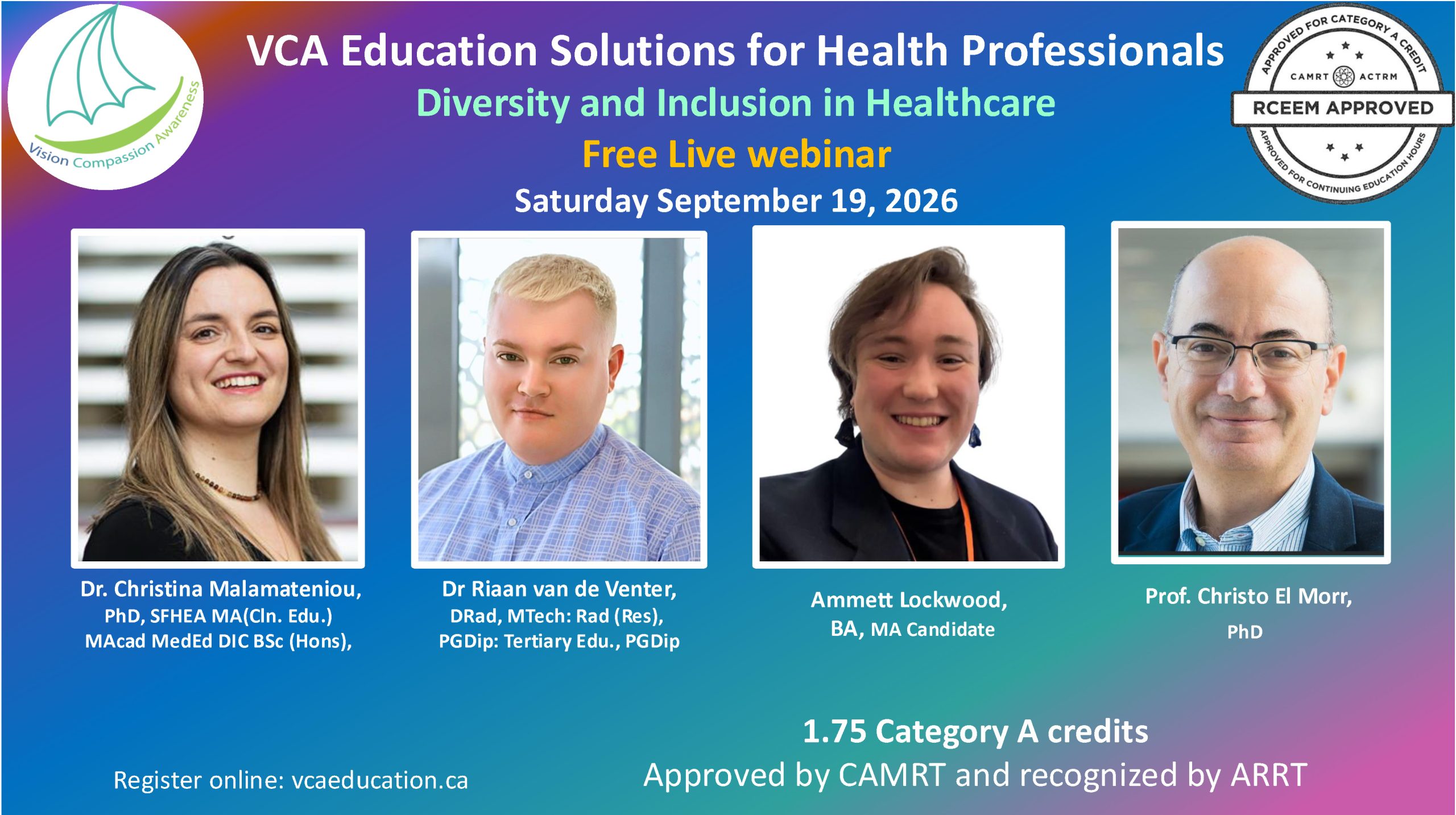
Dr. Christina Malamateniou, PhD SFHEA MA(Cln. Education) MAcad MedEd DIC BSc (Hons) – Christina is the Director of the postgraduate programme of radiography at City, University of London and a Visiting Professor of Radiography at HESAV University in Switzerland (2022-2023). She is a widely published researcher in medical imaging 9h-index 19, 63 publications, 6 standards, 6 scientific reports), with more than £3.25 million in research grants in her name as PI and Co-I and an enthusiastic educator. Her area of research revolves around AI adoption and education in radiography, person centred care and supporting the workforce in its recovery after the Covid19 pandemic. Christina is also the chair of the AI advisory group of the SCoR and the new Chair of research for the EFRS from April 2023-2025. She works as NIHR imaging science working group member and is an elected member of the EuSomII Board. She is an associate editor with JMIRS and a regular reviewer for Radiography. Christina believes in leading from the heart and in the power (and fun) of collaborative work.
Dr. Dr. Riaan van de Venter, DRad, MTech: Rad (Res), PGDip: Tertiary Edu., PGDip: Dr Riaan van de Venter is a senior lecturer and researcher in the Department of Radiography at Nelson Mandela University. Their professional background is in diagnostic radiography, bioethics, health law, tertiary education and distance higher education. They have several peer-reviewed publications in both national and international journals, numerous book chapter contributions and presented podium and poster presentations internationally and nationally. They also presented multiple guest lectures in South Africa, the UK and Canada. Riaan is also an NRF Y-rated researcher. They are an Associate Editor for the Journal of Medical Imaging and Radiation Sciences (Canada) and the Editor-in-Chief for The South African Radiographer (South Africa). They also represent the Society of Radiographers of South Africa (SORSA) at the International Society of Radiographers and Radiological Technologists (ISRRT). Riaan’s research focuses on workforce development, professional education, artificial intelligence, role extension, image interpretation, person-centred care, radiation protection, occupational wellbeing and stress, trauma, as well as gender and sexual diversity. They specialise in qualitative research, systematic literature reviews and visual methodologies.
Emmett Lockwood, BA, MA Candidate: Emmett Lockwood (he/they) is a current MA and incoming PhD student in Critical Disability Studies at York University. Emmett is a mixed Pimicikamak Cree and white researcher. He is a graduate research assistant for the MINO Lab where his research focuses on how barriers to Hepatitis C care in First Nations communities in Canada must be understood as part of ongoing settler-colonialism. He also has a background in federal health policy, having worked as an intern for the United States Senate Committee on Health, Education, Labour and Pensions under U.S. Senator Bernie Sanders.
Christo El Morr, PhD: Dr. Christo El Morr is a global authority in health informatics and equity-driven digital health. A Professor at York University and Director of the Centre for Feminist Research, his scholarship sits at the critical intersection of technology and social justice, with a pioneering focus on AI and Equity. He is the author and editor of several volumes examining artificial intelligence through both technical and critical lenses.